
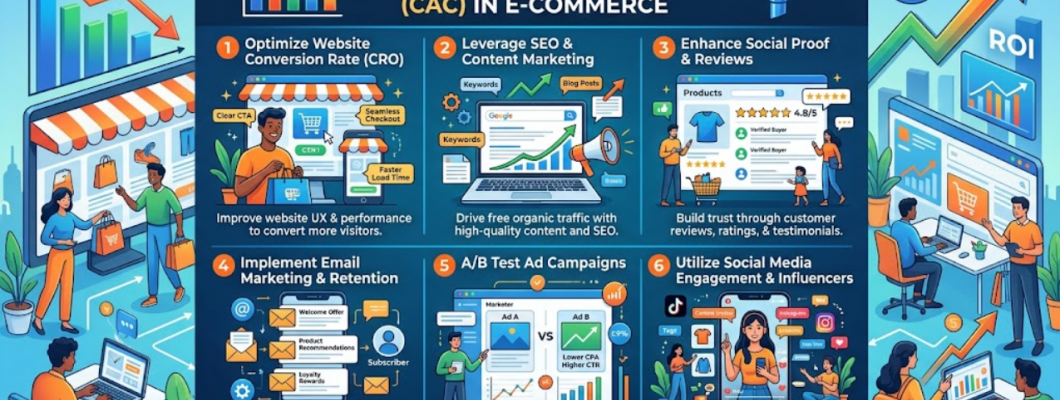
In today’s rapidly expanding e-commerce landscape, attracting new customers is crucial but it can be expensive. With rising competition and increasing ad costs, businesses need smarter strategies to acquire customers without overspending. This makes reducing Customer Acquisition Cost (CAC) a key focus for long-term success.
Lowering CAC helps improve profit margins and allows businesses to scale more efficiently. Instead of simply increasing budgets, brands must focus on optimizing how they spend targeting the right audience, improving campaign performance, and enhancing the overall customer journey.
By refining each step from awareness to conversion businesses can reduce wasted spend and achieve better results. A strategic approach to CAC not only boosts return on investment (ROI) but also supports sustainable and consistent growth.
Let’s explore effective strategies to reduce CAC and drive stronger e-commerce performance.
What is Customer Acquisition Cost (CAC)?
Customer Acquisition Cost (CAC) refers to the total cost of acquiring a new customer. It includes:
Advertising spend
Marketing expenses
Sales costs
Tools and software
Formula:
CAC = Total Marketing & Sales Costs ÷ Number of New Customers
Why Reducing CAC is Important
1. Improves Profit Margins
Lower acquisition costs mean higher profits per customer.
2. Enables Scalable Growth
Efficient spending allows you to scale campaigns without overspending.
3. Increases ROI
Better cost control leads to higher return on investment.
Common Reasons for High CAC
Poor audience targeting
Ineffective ad creatives
Low conversion rates
High competition
Weak retention strategies
Identifying these issues is the first step toward improvement.
1. Optimize Audience Targeting
Reaching the right audience is crucial for reducing wasted spend.
Strategies:
Use data-driven targeting
Segment audiences based on behavior
Focus on high-intent users
Build lookalike audiences
Better targeting leads to higher conversions and lower costs.
2. Improve Conversion Rates
Driving traffic is only half the job—converting that traffic is key.
Optimization Tips:
Simplify website navigation
Use clear CTAs
Improve page load speed
Add trust signals (reviews, testimonials)
Higher conversion rates reduce CAC by increasing efficiency.
3. Leverage Retargeting Campaigns
Retargeting focuses on users who have already shown interest.
Benefits:
Higher conversion rates
Lower acquisition cost
Improved ROI
Target:
Website visitors
Cart abandoners
Product viewers
4. Focus on Organic Channels
Reducing reliance on paid ads can significantly lower CAC.
Organic Strategies:
Search engine optimization (SEO)
Content marketing
Social media engagement
Email marketing
Organic traffic is cost-effective and sustainable.
5. Use Referral Programs
Encourage existing customers to bring in new ones.
Incentives:
Discounts
Rewards
Cashback offers
Referral marketing reduces acquisition costs and builds trust.
6. Optimize Ad Creatives
Strong creatives improve engagement and conversions.
Best Practices:
Use high-quality visuals
Write compelling copy
Highlight benefits
Test multiple variations
Better ads = better results at lower costs.
7. Implement A/B Testing
Testing helps identify what works best.
Test Elements:
Headlines
Images
Landing pages
CTAs
Continuous testing improves performance and reduces waste.
8. Improve Customer Retention
Acquiring new customers is more expensive than retaining existing ones.
Retention Strategies:
Loyalty programs
Personalized offers
Email campaigns
Excellent customer service
Repeat customers lower overall CAC.
9. Increase Average Order Value (AOV)
Higher AOV improves profitability, reducing pressure on CAC.
Techniques:
Upselling
Cross-selling
Bundle offers
More revenue per customer offsets acquisition costs.
10. Use Marketing Automation
Automation saves time and improves efficiency.
Examples:
Email sequences
Chatbots
Retargeting ads
Automation ensures consistent engagement with minimal effort.
11. Optimize Checkout Process
A complicated checkout process can increase abandonment rates.
Fixes:
Reduce steps
Offer multiple payment options
Enable guest checkout
Ensure mobile optimization
A smoother checkout improves conversions.
12. Invest in Data and Analytics
Data helps you make smarter decisions.
Track:
Conversion rates
Customer behavior
Campaign performance
Use insights to refine strategies and reduce costs.
13. Focus on High-Performing Channels
Not all marketing channels deliver equal results.
Action Plan:
Identify top-performing channels
Allocate more budget to them
Reduce spend on underperforming ones
This improves efficiency and lowers CAC.
14. Build Strong Brand Trust
Trust plays a major role in customer decisions.
Ways to Build Trust:
Customer reviews
Transparent policies
Quality products
Reliable service
Trusted brands convert faster and cheaper.
15. Use Influencer and Affiliate Marketing
Collaborating with influencers can help reach targeted audiences.
Benefits:
Lower acquisition costs
Higher credibility
Increased reach
Affiliate marketing also ensures you pay only for results.
Advanced Strategies to Reduce CAC
1. Use AI and Machine Learning
Optimize campaigns automatically for better performance.
2. Personalize Customer Experiences
Tailored messaging increases engagement and conversions.
3. Focus on Customer Lifetime Value (CLV)
Balance CAC with long-term customer value.
Real-World Example
Scenario:
An e-commerce brand reduces CAC by:
Improving targeting
Running retargeting campaigns
Optimizing landing pages
Results:
Higher conversion rate
Lower cost per acquisition
Increased ROI
Common Mistakes to Avoid
Ignoring data insights
Over-relying on paid ads
Not testing campaigns
Targeting the wrong audience
Neglecting retention strategies
Avoiding these mistakes ensures better results.
Key Metrics to Monitor
Customer Acquisition Cost (CAC)
Conversion rate
Return on ad spend (ROAS)
Customer lifetime value (CLV)
Tracking these metrics helps maintain efficiency.
Conclusion
Reducing Customer Acquisition Cost in e-commerce is essential for long-term success. By optimizing targeting, improving conversions, leveraging organic channels, and focusing on customer retention, businesses can significantly lower costs while increasing profitability.
The key is continuous improvement—testing, analyzing, and refining your strategies to stay ahead in a competitive market.
Start implementing these techniques today and turn your acquisition strategy into a cost-efficient growth engine.
Leave a Comment