
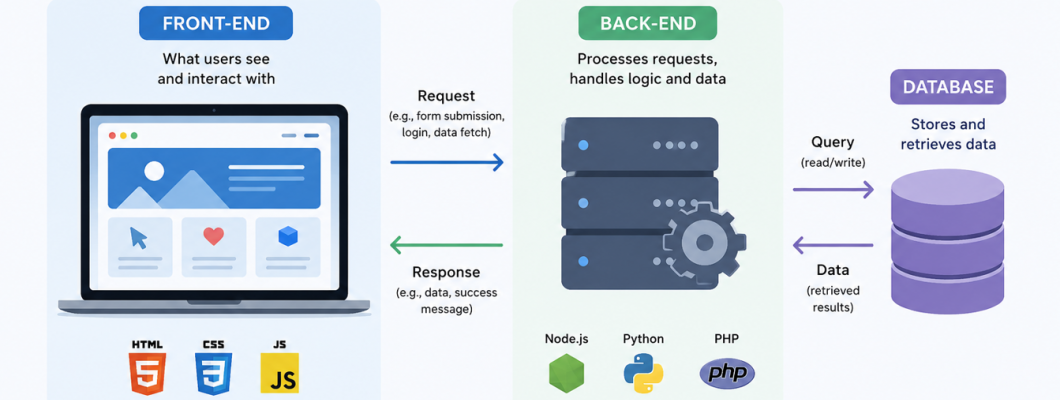
Modern websites have evolved far beyond basic pages with simple text and images. In 2026, websites are faster, smarter, and more interactive, offering features like online shopping, video streaming, social networking, cloud services, and real-time communication. Behind these seamless digital experiences is the powerful collaboration between front-end and back-end development.
The front-end focuses on everything users see and interact with, including layouts, animations, buttons, and responsive designs. Meanwhile, the back-end handles the behind-the-scenes operations such as databases, servers, security, APIs, and data processing. Together, these technologies ensure websites run smoothly, securely, and efficiently.
While users mainly notice attractive designs and smooth navigation, the real functionality depends on strong coordination between both sides of development. Every click, login, search, or transaction relies on communication between the user interface and server-side systems.
Understanding how front-end and back-end development work together is essential for developers, business owners, students, and anyone interested in modern web technology. As digital experiences continue to evolve, mastering both aspects of web development has become increasingly important for building powerful, scalable, and user-friendly websites.
What Is Front-End Development?
Front-end development focuses on the visual and interactive parts of a website that users directly see and interact with.
Everything displayed in a web browser—including buttons, menus, images, forms, animations, and layouts—is created through front-end development.
Front-end developers aim to create websites that are:
Visually attractive
Easy to navigate
Responsive on all devices
Fast-loading
User-friendly
The front-end acts as the bridge between users and the website’s functionality.
Main Technologies Used in Front-End Development
Modern front-end development relies on several core technologies.
HTML
HTML (HyperText Markup Language) forms the structure of web pages. It organizes content such as headings, text, images, and forms.
CSS
CSS (Cascading Style Sheets) controls the appearance of websites, including colors, layouts, spacing, fonts, and responsive designs.
JavaScript
JavaScript adds interactivity and dynamic behavior to websites.
It powers features such as:
Sliders
Popups
Search filters
Real-time updates
Interactive forms
Animations
Without JavaScript, websites would feel static and limited.
Front-End Frameworks
Modern websites often use frameworks like:
React
Angular
Vue.js
These frameworks simplify development and improve performance for complex applications.
What Is Back-End Development?
Back-end development handles the server-side operations that users usually cannot see directly.
The back-end manages:
Databases
User authentication
Application logic
APIs
Data processing
Security
Server communication
Whenever users log in, submit forms, make payments, or interact with dynamic content, the back-end processes those requests.
Main Technologies Used in Back-End Development
Back-end developers use programming languages, servers, and databases to manage website functionality.
Programming Languages
Popular back-end languages include:
Node.js
Python
PHP
Java
Ruby
Go
Each language offers different advantages depending on project requirements.
Databases
Databases store and organize website information.
Popular databases include:
SQL Databases
MySQL
PostgreSQL
NoSQL Databases
MongoDB
Firebase
Databases allow websites to manage user accounts, products, comments, transactions, and other important data.
Servers
Servers process requests and deliver information to users’ browsers.
Common server technologies include:
Apache
Nginx
Express.js
Servers act as the communication center between the front-end and the database.
How Front-End and Back-End Work Together
Front-end and back-end development are deeply connected. A website functions smoothly only when both sides communicate effectively.
Here is how the process works step by step.
Step 1: User Interaction on the Front-End
The process begins when a user interacts with a website.
Examples include:
Clicking a button
Filling out a form
Logging into an account
Searching for products
Posting comments
The front-end captures these actions using JavaScript and sends requests to the back-end.
Step 2: Requests Sent to the Back-End
When users submit information, the front-end sends a request to the server using APIs.
For example:
Login requests
Product searches
Payment processing
File uploads
The back-end receives these requests and decides what actions to perform.
Step 3: Back-End Processes the Data
The back-end processes the request using application logic and database operations.
Examples include:
Checking login credentials
Searching databases
Storing user information
Verifying payments
Fetching content
Security checks also happen during this stage.
Step 4: Database Communication
The server communicates with databases to retrieve or store information.
For example:
User account details
Product inventories
Social media posts
Booking information
The database returns the requested data to the server.
Step 5: Response Sent Back to the Front-End
Once the back-end processes the request, it sends a response back to the front-end.
The response may include:
User information
Search results
Error messages
Confirmation messages
Updated content
The front-end then displays the information visually to the user.
Real-World Example: Online Shopping Website
An e-commerce website is a perfect example of front-end and back-end collaboration.
Front-End Responsibilities
The front-end displays:
Product images
Search bars
Shopping carts
Checkout pages
Buttons and menus
Users interact with these elements directly.
Back-End Responsibilities
The back-end handles:
Inventory management
Payment processing
User authentication
Order storage
Shipping calculations
When users click “Buy Now,” the back-end securely processes the transaction and updates the database.
APIs: The Connection Between Front-End and Back-End
APIs (Application Programming Interfaces) are essential for communication between front-end and back-end systems.
APIs allow websites and applications to exchange data smoothly.
Examples include:
Social media logins
Payment gateways
Weather data
AI integrations
Maps and location services
Modern websites rely heavily on APIs to provide advanced functionality.
Importance of Responsive Design
Front-end developers ensure websites work properly on:
Smartphones
Tablets
Laptops
Large desktop screens
Responsive design improves:
User experience
Accessibility
SEO rankings
Customer engagement
Meanwhile, the back-end ensures data and functionality remain consistent across all devices.
Security in Modern Websites
Security is one of the most important responsibilities of back-end systems.
Modern websites must protect users from:
Data breaches
Hacking attempts
Unauthorized access
Malware
Fraudulent transactions
Back-end developers implement:
Encryption
Authentication systems
Secure APIs
Firewall protection
Data validation
Front-end developers also contribute by creating secure forms and preventing harmful user input.
Performance Optimization
Website speed directly affects user satisfaction and search engine rankings.
Front-end optimization includes:
Compressing images
Reducing unnecessary scripts
Lazy loading
Efficient styling
Back-end optimization includes:
Faster database queries
Efficient server management
Caching systems
Content delivery networks (CDNs)
Both sides work together to improve loading speed and overall performance
Role of Full-Stack Developers
Full-stack developers understand both front-end and back-end development.
They can:
Build complete applications
Handle server-side logic
Design user interfaces
Manage databases
Deploy websites
Full-stack developers are highly valuable because they understand the complete workflow of web applications.
Cloud Computing and Modern Web Development
Cloud technology has transformed how websites are built and managed.
Modern websites often use cloud services for:
Hosting
Database storage
Scalability
Security
Performance monitoring
Popular cloud platforms include:
AWS
Google Cloud
Microsoft Azure
Cloud infrastructure allows websites to handle large numbers of users efficiently.
AI Integration in Modern Websites
Artificial intelligence is becoming increasingly common in web development.
Front-end AI features include:
Chatbots
Personalized recommendations
Voice search
Smart search filters
Back-end AI systems process:
User behavior
Data analysis
Automation
Machine learning models
AI helps websites become more intelligent and personalized.
Common Challenges in Front-End and Back-End Collaboration
Although front-end and back-end teams work closely together, challenges can arise.
Communication Issues
Miscommunication between teams can lead to inconsistent features or delays.
API Errors
Broken APIs can prevent data from loading correctly on the front-end.
Performance Bottlenecks
Poor server optimization or heavy front-end scripts may slow websites down.
Security Risks
Weak security practices can expose sensitive user data.
Proper planning and teamwork are essential for solving these challenges.
The Future of Modern Website Development
The future of web development continues to evolve rapidly.
Emerging trends include:
AI-powered development
Serverless architecture
Progressive Web Apps (PWAs)
Voice-enabled interfaces
Web3 technologies
Edge computing
Front-end and back-end systems will continue becoming more connected, efficient, and intelligent.
Why Understanding Both Sides Matters
Even if someone specializes in one area, understanding both front-end and back-end development offers many advantages.
Benefits include:
Better collaboration
Faster problem-solving
Improved project management
Enhanced development efficiency
Greater career opportunities
Businesses also benefit when teams understand how all parts of a website work together.
Final Thoughts
Modern websites depend on the seamless collaboration between front-end and back-end development. The front-end creates engaging visual experiences for users, while the back-end powers the functionality, security, and data management that keep websites running smoothly.
Together, these technologies create the interactive digital experiences people use every day from social media platforms and online stores to streaming services and business applications.
As technology continues advancing in 2026, the relationship between front-end and back-end development will become even more important. Developers who understand both sides of the process will be better prepared to build fast, secure, scalable, and user-friendly websites for the future.
Whether you are a beginner learning web development or a business owner exploring digital solutions, understanding how front-end and back-end systems work together is essential in today’s modern internet-driven world.
Leave a Comment