
In today’s data-driven marketing landscape, knowing what truly drives conversions is essential. Businesses spend heavily on digital campaigns, but without the right attribution model, it’s hard to determine which touchpoints actually deliver results. This challenge is even more important in PTC (Pay-To-Click) campaigns, where every click has a direct cost.
An effective attribution model helps marketers understand the customer journey, assign value to each interaction, and make smarter decisions. Without it, you risk investing in channels that don’t contribute to conversions while overlooking those that do.
By choosing the right attribution approach, businesses can allocate budgets more efficiently, optimize campaign performance, and improve overall return on investment (ROI). It also enables better tracking of user behavior across multiple channels, offering deeper insights into what influences conversions.
However, with various attribution models available each offering a different perspective the key question is: which one works best for PTC campaigns?
Understanding how these models impact performance is crucial to building a strategy that maximizes results while minimizing wasted spend.
What is an Attribution Model?
An attribution model is a framework that determines how credit for conversions is assigned to different touchpoints in a customer’s journey.
For example, a user might:
Click an ad
Visit your website
See a retargeting ad
Finally, make a purchase
An attribution model decides which of these interactions gets credit for the conversion.
Why Attribution Matters for PTC Campaigns
In PTC campaigns, you pay for every click. Without proper attribution:
You may invest in the wrong channels
High-performing touchpoints may be overlooked
Budget allocation becomes inefficient
ROI may decline
Accurate attribution ensures you understand which clicks actually drive value.
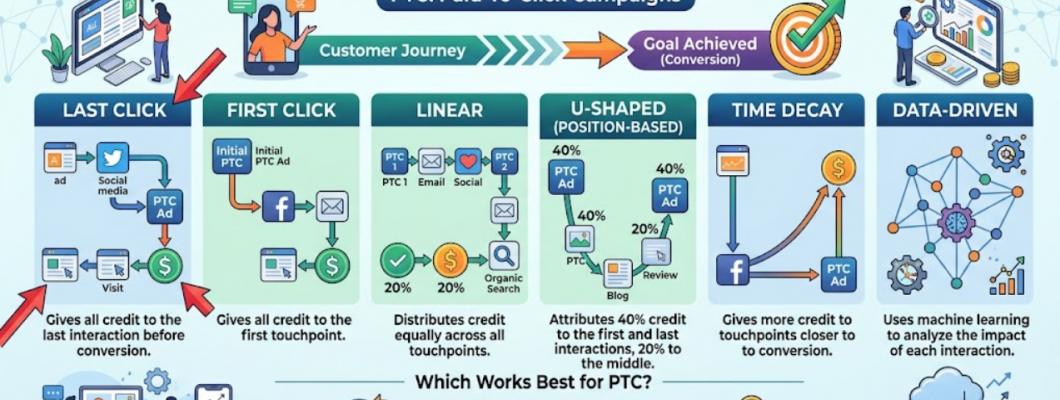
Types of Attribution Models
1. Last-Click Attribution
How it works:
Gives 100% credit to the final interaction before conversion.
Pros:
Simple and easy to implement
Highlights closing touchpoints
Cons:
Ignores earlier interactions
Can undervalue awareness campaigns
Best for:
Short sales cycles and direct-response campaigns.
2. First-Click Attribution
How it works:
Assigns full credit to the first interaction.
Pros:
Identifies channels that drive initial interest
Useful for awareness analysis
Cons:
Ignores later interactions
Doesn’t reflect the full customer journey
Best for:
Top-of-funnel campaigns.
3. Linear Attribution
How it works:
Distributes credit equally across all touchpoints.
Pros:
Balanced view of the customer journey
Recognizes all interactions
Cons:
Treats all touchpoints equally, even if impact differs
Best for:
Businesses with longer sales cycles.
4. Time Decay Attribution
How it works:
Gives more credit to interactions closer to conversion.
Pros:
Emphasizes recent actions
Reflects decision-making behavior
Cons:
May undervalue early-stage interactions
Best for:
Campaigns with nurturing phases.
5. Position-Based (U-Shaped) Attribution
How it works:
Assigns:
40% credit to the first interaction
40% to last interaction
20% distributed among others
Pros:
Balances awareness and conversion
Highlights key touchpoints
Cons:
May oversimplify complex journeys
Best for:
Multi-channel campaigns.
6. Data-Driven Attribution
How it works:
Uses algorithms and data to assign credit based on actual performance.
Pros:
Highly accurate
Adapts to real user behavior
Optimizes campaigns effectively
Cons:
Requires large data sets
More complex to implement
Best for:
Advanced marketers and high-volume campaigns.
Which Attribution Model Works Best for PTC?
There is no one-size-fits-all answer—it depends on your campaign goals, data availability, and customer journey.
Recommended Approach:
For Beginners:
Start with Last-Click Attribution for simplicity and quick insights.
For Balanced Insights:
Use Position-Based Attribution to understand both awareness and conversion.
For Advanced Optimization:
Adopt Data-Driven Attribution for the most accurate and scalable results.
Factors to Consider When Choosing a Model
1. Campaign Goals
Awareness → First-click
Conversions → Last-click
Full journey → Multi-touch models
2. Sales Cycle Length
Short cycles → Last-click
Long cycles → Linear or time decay
3. Data Availability
Limited data → Simpler models
Large datasets → Data-driven models
4. Marketing Channels
Single channel → Simple attribution
Multi-channel → Advanced models
How Attribution Impacts PTC Performance
1. Better Budget Allocation
Allocate more budget and focus on touchpoints that consistently deliver strong performance and drive higher engagement and conversions.
2. Improved Campaign Optimization
Determine which clicks truly lead to conversions, helping you focus on high-impact interactions that generate real results.
3. Enhanced ROI
Cut unnecessary spending and improve efficiency by focusing resources on strategies that deliver better performance and higher returns.
Common Attribution Mistakes
Relying only on last-click attribution
Ignoring multi-touch interactions
Not updating attribution models
Overlooking data quality
Avoiding these mistakes leads to better decision-making.
Best Practices for PTC Attribution
1. Combine Multiple Models
Compare different attribution models to gain deeper insights and make more informed, data-driven marketing decisions.
2. Track the Full Customer Journey
Analyze how users engage and move across different channels to optimize marketing strategies and improve overall campaign performance.
3. Use Analytics Tools
Use platforms offering attribution insights to track performance, understand customer journeys, and optimize marketing campaigns effectively.
4. Test and Optimize Regularly
Continuously improve your strategy by analyzing performance data and making adjustments to enhance results and campaign effectiveness.
Real-World Example
Scenario:
A business runs PTC campaigns across multiple channels.
Using Last-Click Attribution:
Search ads appear to perform best
Using Data-Driven Attribution:
Social media ads play a key role in early engagement
Result:
Budget is reallocated
Overall conversions increase
ROI improves
Future of Attribution in PTC
1. AI and Machine Learning
Highly accurate, automated attribution models that use advanced data and algorithms to track performance and optimize marketing decisions effectively.
2. Privacy-First Tracking
Move toward first-party data and consent-based tracking to ensure privacy, build trust, and maintain effective, compliant marketing strategies.
3. Cross-Channel Integration
Seamless tracking across multiple platforms to provide consistent data insights and improve campaign performance and decision-making.
Key Takeaways
Attribution models determine how credit is assigned to conversions
Choosing the right model improves PTC campaign performance
Multi-touch and data-driven models offer better insights
Continuous testing is essential for success
Conclusion
Attribution models play a crucial role in understanding and optimizing PTC campaigns. While simpler models like last-click provide quick insights, they often fail to capture the full customer journey. More advanced approaches, such as data-driven attribution, offer deeper and more accurate insights into user behavior.
The best strategy is to align your attribution model with your business goals, data capabilities, and campaign complexity. By doing so, you can make smarter decisions, allocate budgets effectively, and maximize your ROI.
Start evaluating your attribution strategy today and unlock the full potential of your PTC campaigns.
Leave a Comment