
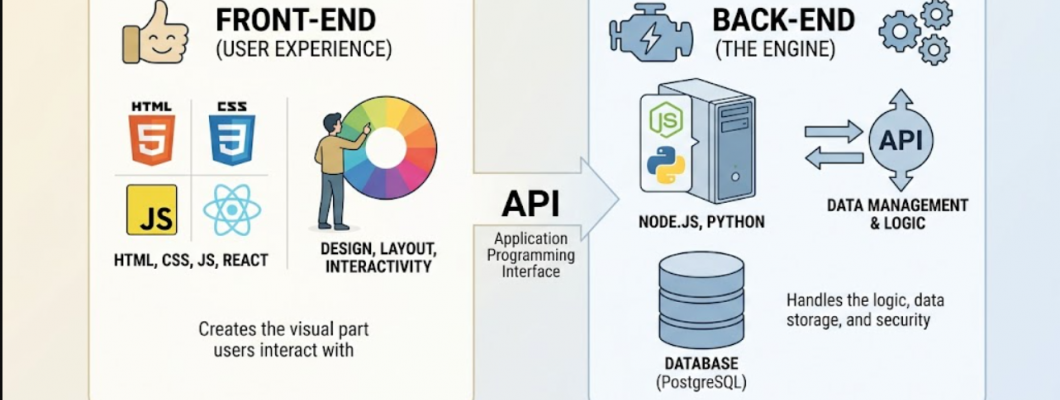
In today’s digital world, websites and applications drive everything from online shopping and social media to business operations. Behind these smooth and interactive experiences are two core components of web development: front-end and back-end development.
The front-end focuses on what users see and interact with, such as design, layout, and navigation. The back-end, on the other hand, works behind the scenes, managing data, servers, and application logic. Both play equally important roles but require different skills and approaches.
Whether you’re new to web development or thinking about a career change, understanding the differences between front-end and back-end development is essential. This guide will help you explore their roles, tools, key distinctions, and career paths, making it easier to decide which direction suits you best.
What is Front-End Development?
Front-end development, also known as client-side development, focuses on everything users see and interact with on a website or application.
Key Responsibilities:
Designing and structuring web pages
Creating responsive layouts for different devices
Adding interactivity and animations
Enhancing user experience (UX)
Core Technologies:
HTML – Defines the structure of content
CSS – Controls layout and design
JavaScript – Adds interactivity
Popular Frameworks & Libraries:
React
Angular
Vue.js
Tools Used:
Code editors (VS Code)
Browser developer tools
Version control (Git, GitHub)
Front-end developers focus on creating visually appealing and user-friendly interfaces.
What is Back-End Development?
Back-end development, or server-side development, manages everything behind the scenes that users don’t see.
Key Responsibilities:
Handling server logic
Managing databases
Processing user requests
Ensuring security and authentication
Common Technologies:
Languages: Python, Java, PHP, Node.js
Databases: MySQL, PostgreSQL, MongoDB
Servers: Apache, Nginx
Tools Used:
API tools (Postman)
Database management tools
Server frameworks (Django, Express.js)
Back-end developers ensure that applications run smoothly, securely, and efficiently.
Front-End vs Back-End: Key Differences

How They Work Together
Front-end and back-end development are not isolated—they work together to create a complete application.
Example Workflow:
A user fills out a form on a website.
The front-end collects the input data.
The data is sent to the back-end via an API.
The back-end processes the request and stores or retrieves data from the database.
The response is sent back to the front-end.
The front-end displays the result to the user.
This seamless interaction ensures a smooth user experience.
Essential Tools for Both Roles
Front-End Tools:
HTML, CSS, JavaScript
React, Angular, Vue.js
Bootstrap, Tailwind CSS
Chrome DevTools
Back-End Tools:
Node.js, Django, Spring Boot
MySQL, MongoDB
Postman (API testing)
Docker (containerization)
Shared Tools:
Git & GitHub (version control)
CI/CD tools for deployment
Career Guide: Front-End vs Back-End
Choosing between front-end and back-end depends on your interests and strengths.
Front-End Developer Career
Ideal For:
Creative thinkers
People interested in design and UI/UX
Those who enjoy visual problem-solving
Skills Required:
Strong understanding of design principles
Proficiency in HTML, CSS, JavaScript
Knowledge of frameworks
Job Roles:
Front-End Developer
UI Developer
Web Designer
Back-End Developer Career
Ideal For:
Logical thinkers
Problem solvers
Those interested in data and systems
Skills Required:
Programming languages (Python, Java, etc.)
Database management
API development
Job Roles:
Back-End Developer
Software Engineer
Database Administrator
What is Full-Stack Development?
A full-stack developer works on both front-end and back-end technologies.
Benefits:
High demand in the job market
Ability to build complete applications
Better understanding of system architecture
Skills Required:
Front-end and back-end technologies
Database management
API integration
Version control
Full-stack development offers flexibility and broader career opportunities.
Salary & Demand Trends
Both front-end and back-end developers are in high demand globally.
Factors Influencing Salary:
Experience level
Skill set and technologies
Location and industry
Market Demand:
Growing need for web applications
Increased focus on digital transformation
Rise of startups and tech companies
Learning either path can lead to rewarding career opportunities.
Latest Trends in Web Development
Front-End Trends:
AI-powered interfaces
Progressive Web Apps (PWAs)
Motion UI and animations
Back-End Trends:
Serverless architecture
Microservices
Cloud computing
Combined Trends:
API-first development
Headless CMS
Real-time applications
Staying updated with trends helps developers remain competitive.
How to Get Started
Step 1: Learn the Basics
Start with HTML, CSS, and JavaScript.
Step 2: Choose Your Path
Love design? Go for front-end
Prefer logic? Choose back-end
Step 3: Build Projects
Portfolio websites
Blog platforms
To-do apps
Step 4: Learn Advanced Tools
Explore frameworks, APIs, and databases.
Step 5: Create a Portfolio
Showcase your work to employers or clients.
Tips for Success
Practice coding regularly
Work on real-world projects
Stay updated with trends
Join developer communities
Focus on problem-solving
Consistency is key to becoming a successful developer.
Conclusion
Front-end and back-end development are the two pillars of modern web development, each playing a unique yet interconnected role. While the front-end focuses on creating engaging and user-friendly interfaces, the back-end ensures functionality, performance, and security.
Choosing between the two depends on your interests, skills, and career goals. If you enjoy design and user interaction, front-end development might be the right path. If you prefer working with logic, data, and systems, back-end development could be a better fit.
Alternatively, mastering both as a full-stack developer can open even more opportunities.
No matter which path you choose, understanding how these two domains work together will give you a strong foundation in web development and help you build powerful, scalable applications.
Leave a Comment