
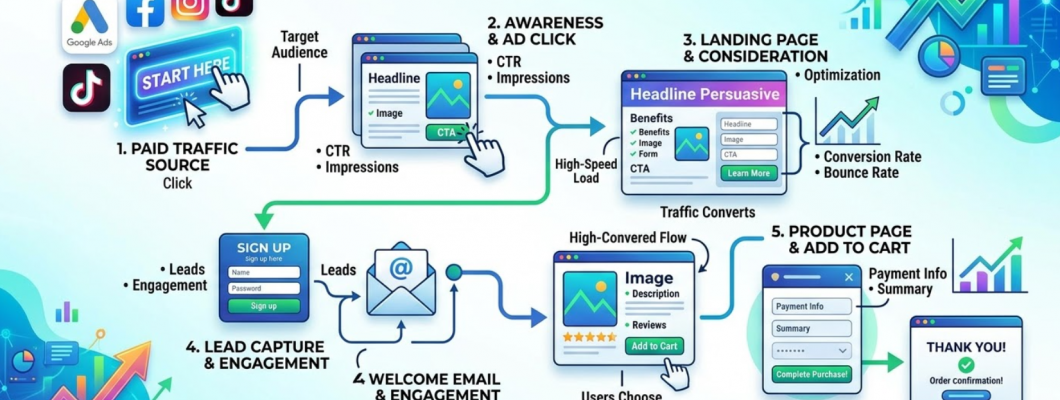
In digital marketing, generating traffic through paid ads is just the first step. The real challenge is converting that traffic into paying customers. Many businesses invest heavily in advertising but overlook optimizing the user journey after the click. This gap between the initial click and the final purchase is where a significant number of potential conversions are lost.
Optimizing the paid traffic funnel means refining every stage of the customer journey from the moment a user clicks on an ad to the point they complete a purchase. Each step should be designed to provide a smooth, engaging, and friction-free experience that encourages users to move closer to conversion.
A well-optimized funnel not only improves conversion rates but also maximizes return on ad spend (ROAS), ensuring that marketing budgets are used efficiently. By reducing drop-offs and enhancing user experience, businesses can turn more visitors into loyal customers.
This article explores practical strategies to optimize each stage of the paid traffic funnel, helping businesses improve conversions, minimize losses, and achieve sustainable growth in an increasingly competitive digital landscape.
Understanding the Paid Traffic Funnel
The paid traffic funnel represents the journey a user takes after clicking on an advertisement. It typically includes the following stages:
Ad Click – The user clicks on your paid ad
Landing Page – The user arrives on a targeted page
Engagement – The user interacts with your content
Conversion Action – The user adds a product or signs up
Checkout – The user completes the purchase
Each stage plays a critical role in influencing user behavior. Even small inefficiencies can lead to significant drop-offs.
Why Funnel Optimization Matters
Without proper optimization, businesses may experience:
High bounce rates
Low conversion rates
Wasted ad spend
Poor user experience
By optimizing the funnel, you can:
Improve conversion rates
Increase revenue without increasing ad spend
Enhance user experience
Build trust with potential customers
Stage 1: Optimizing the Ad Click
The funnel begins with your ad. If your ad fails to attract the right audience or sets incorrect expectations, the rest of the funnel will suffer.
Key Strategies:
1. Target the Right Audience
Use detailed audience targeting to reach users who are most likely to convert. Consider demographics, interests, and behaviors.
2. Align Ad Messaging with Intent
Your ad copy should match the user’s search intent or interest. Misleading ads may generate clicks but lead to high bounce rates.
3. Use Clear Call-to-Actions
Encourage users to take action with strong CTAs like “Shop Now,” “Get Started,” or “Claim Your Offer.”
4. Test Ad Variations
Run A/B tests on headlines, visuals, and formats to identify the best-performing ads.
Stage 2: Optimizing the Landing Page
Once users click your ad, they land on your page. This is where first impressions are formed.
Best Practices:
1. Maintain Message Consistency
Ensure the landing page matches the promise made in the ad. Consistency builds trust.
2. Use a Clear Value Proposition
Immediately communicate why your product or service is valuable.
3. Keep the Design Clean and Focused
Avoid clutter. A simple, well-structured layout helps users focus on the main action.
4. Optimize for Speed
Slow-loading pages can drive users away. Fast load times are essential for conversions.
5. Include Strong CTAs
Place clear and visible call-to-action buttons throughout the page.
Stage 3: Improving User Engagement
After landing on your page, users need to be engaged and guided toward conversion.
Strategies to Increase Engagement:
1. Use High-Quality Visuals
Images and videos help showcase your product effectively.
2. Add Social Proof
Customer reviews, testimonials, and ratings build trust and credibility.
3. Provide Clear Information
Answer common questions and address objections upfront.
4. Use Interactive Elements
Features like product filters, chat support, or quizzes can enhance user experience.
Stage 4: Optimizing the Conversion Action
This stage involves encouraging users to take a key action, such as adding a product to the cart or signing up.
Key Techniques:
1. Simplify the Process
Reduce the number of steps required to complete an action.
2. Create Urgency
Use limited-time offers or stock alerts to encourage immediate action.
3. Offer Incentives
Discounts, free shipping, or bonuses can increase conversions.
4. Highlight Benefits Over Features
Focus on how the product solves problems rather than just listing features.
Stage 5: Streamlining the Checkout Process
The checkout stage is where many conversions are lost. A complicated or lengthy checkout can cause users to abandon their carts.
Optimization Tips:
1. Reduce Form Fields
Ask only for essential information.
2. Enable Guest Checkout
Allow users to complete purchases without creating an account.
3. Provide Multiple Payment Options
Offer flexibility with different payment methods.
4. Show Transparent Pricing
Avoid hidden fees that may surprise users at checkout.
5. Build Trust with Security Signals
Display secure payment badges and trust indicators.
Leveraging Retargeting to Recover Lost Conversions
Not all users will convert during their first visit. Retargeting helps bring them back.
Effective Retargeting Strategies:
Show ads for products users viewed
Send abandoned cart reminders
Offer special discounts for returning users
Use personalized messaging
Retargeting campaigns often deliver higher conversion rates because they target warm audiences.
Using Data to Optimize the Funnel
Data analysis is crucial for identifying weaknesses in your funnel.
Important Metrics to Track:
Click-through rate (CTR)
Bounce rate
Conversion rate
Cart abandonment rate
Return on ad spend (ROAS)
Analyzing these metrics helps you understand where users drop off and what improvements are needed.
A/B Testing for Continuous Improvement
Optimization is an ongoing process. Regular testing ensures your funnel continues to perform well.
Elements to Test:
Ad creatives
Landing page headlines
CTA placements
Pricing strategies
Checkout designs
Small changes can lead to significant improvements in performance.
Common Mistakes to Avoid
Even well-designed funnels can fail if common mistakes are not addressed.
Mismatch between ad and landing page
Slow website performance
Complicated checkout processes
Lack of mobile optimization
Ignoring analytics data
Avoiding these mistakes can significantly improve your funnel efficiency.
The Role of Mobile Optimization
A large portion of paid traffic comes from mobile devices. Ensuring a seamless mobile experience is essential.
Mobile Optimization Tips:
Use responsive design
Ensure fast loading speeds
Simplify navigation
Optimize buttons for touch interactions
A mobile-friendly funnel improves user experience and boosts conversions.
Future Trends in Paid Funnel Optimization
As technology evolves, paid traffic funnels are becoming more advanced.
Emerging Trends:
AI-Driven Personalization
Personalized experiences based on user behavior will improve engagement and conversions.
Automation Tools
Automated bidding and targeting will enhance campaign efficiency.
Voice and Visual Search Integration
New search methods will influence how users enter the funnel.
Predictive Analytics
Advanced data analysis will help forecast user behavior and optimize strategies.
Conclusion
Optimizing the paid traffic funnel is essential for turning clicks into customers. Every stage from the initial ad click to the final checkout must be carefully designed to guide users toward conversion.
By aligning ad messaging, improving landing pages, enhancing engagement, simplifying conversion steps, and streamlining checkout processes, businesses can significantly increase their conversion rates and maximize return on investment.
Success in performance marketing is not just about driving traffic it’s about creating a seamless and persuasive journey that converts visitors into loyal customers. Continuous testing, data analysis, and optimization are key to building a high-performing paid traffic funnel that delivers consistent and scalable results.
Leave a Comment