
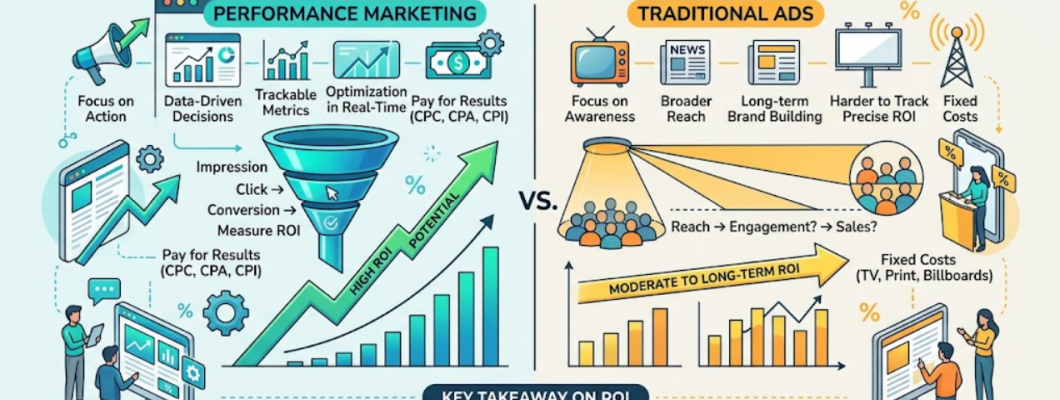
In today’s competitive marketing environment, businesses are focused on maximizing their return on investment (ROI) while choosing the most effective advertising strategies. With a wide range of options available, a common question arises: Should you invest in performance marketing or traditional advertising?
Both approaches offer unique advantages. Traditional advertising helps build strong brand awareness and reach a broad audience, while performance marketing focuses on measurable results and data-driven outcomes. However, when it comes to cost efficiency and tracking performance, the differences between the two can be quite significant.
Understanding how each model contributes to ROI is crucial for making informed marketing decisions. Businesses need to evaluate their goals, budget, and target audience before selecting the right approach.
Let’s take a closer look at performance marketing and traditional advertising to understand their impact and determine which strategy delivers better returns.
What is Performance Marketing?
Performance marketing is a digital advertising approach where businesses pay only for specific actions, such as:
Clicks
Leads
Conversions
Sales
This model is highly data-driven and focuses on measurable outcomes.
Key Channels:
Search engine ads
Social media advertising
Affiliate marketing
Display and native ads
Key Advantage:
You only pay when a desired action is completed, making it highly cost-efficient.
What are Traditional Ads?
Traditional advertising refers to offline marketing methods that have been used for decades.
Common Channels:
Television commercials
Radio ads
Newspaper and magazine ads
Billboards and outdoor advertising
Key Advantage:
Strong brand awareness and mass reach.
Core Difference: Measurement and Accountability
The biggest difference between performance marketing and traditional ads lies in measurability.
Performance Marketing: Fully trackable (clicks, conversions, ROI)
Traditional Ads: Limited tracking and estimation-based results
This directly impacts how ROI is calculated and optimized.
ROI Breakdown: Performance Marketing vs Traditional Ads
1. Cost Efficiency
Performance Marketing:
Pay only for results
Flexible budgets
Lower risk
Traditional Ads:
High upfront costs
Pay regardless of performance
Limited flexibility
Leave a Comment