
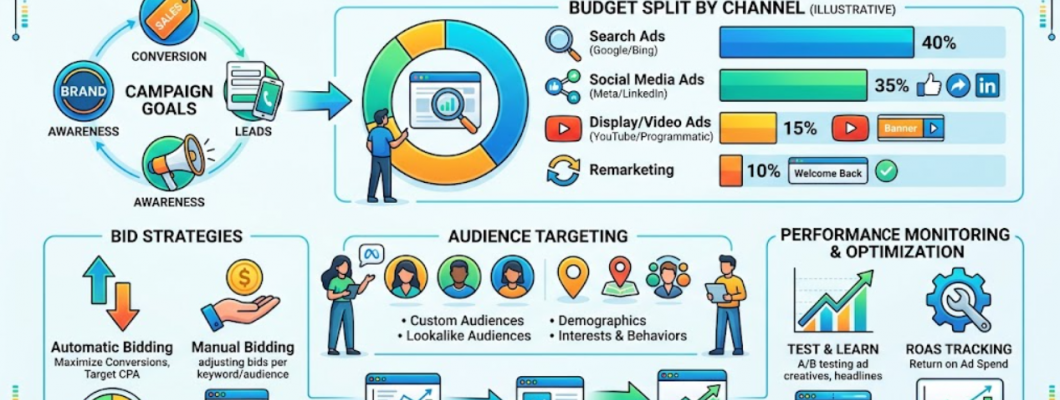
In today’s fast-changing digital marketing landscape, paid campaigns play a crucial role in driving traffic, leads, and sales. However, simply spending money on ads doesn’t guarantee success. The real challenge is how effectively you allocate your budget to maximize returns while minimizing wasted spend.
Smart budget allocation ensures that every rupee is used strategically to support your business goals. Instead of spreading your budget randomly, it focuses on investing in the right channels, campaigns, and audiences that deliver the best results. This approach not only improves efficiency but also enhances overall campaign performance.
Whether you’re a small business or an expanding online brand, understanding how to distribute your ad spend wisely can make a significant difference in your return on investment (ROI). By using data-driven decisions and continuously optimizing your strategy, you can achieve better outcomes from your campaigns.
Let’s explore how to allocate your budget effectively in paid campaigns and drive stronger, more consistent results.
What is Budget Allocation in Paid Campaigns?
Budget allocation refers to how you distribute your advertising spend across:
Platforms (search, social, display)
Campaigns (branding, conversions, retargeting)
Audience segments
Ad creatives
The goal is to invest more in high-performing areas while reducing spend on underperforming ones.
Why Smart Budget Allocation Matters
Effective budget allocation helps you:
Maximize return on investment (ROI)
Reduce wasted ad spend
Improve campaign performance
Reach the right audience at the right time
Scale profitable campaigns efficiently
Without a clear budget strategy, even well-designed campaigns can fail to deliver results.
Common Budget Allocation Mistakes
Before diving into strategies, it’s important to avoid common pitfalls:
Spreading budget too thin across multiple campaigns
Ignoring performance data
Over-investing in low-performing channels
Not allocating budget for testing
Failing to adjust budgets regularly
Recognizing these mistakes is the first step toward improvement.
1. Define Clear Campaign Goals
Your budget allocation should always align with your objectives.
Common Goals:
Brand awareness
Lead generation
Sales and conversions
App installs
Website traffic
Each goal requires a different budget distribution strategy.
Example:
If your goal is conversions, allocate more budget to high-intent campaigns like search and retargeting.
2. Prioritize High-Performing Channels
Not all platforms deliver the same results. Analyze performance data to identify which channels generate the best ROI.
Popular Paid Channels:
Search ads (high intent)
Social media ads (engagement and awareness)
Display ads (remarketing)
Video ads (brand storytelling)
Shift more budget toward platforms that consistently perform well.
3. Use the 70-20-10 Budget Rule
A proven framework for budget allocation:
70% → Proven, high-performing campaigns
20% → Scaling and expanding campaigns
10% → Testing new strategies and audiences
This approach balances stability with innovation.
4. Allocate Budget Based on Funnel Stages
A well-structured funnel ensures better results.
Funnel-Based Allocation:
Top of Funnel (Awareness):
Broad targeting
Video and display ads
Lower budget focus
Middle of Funnel (Consideration):
Engagement campaigns
Product education
Moderate budget
Bottom of Funnel (Conversion):
Retargeting
Search ads
Highest budget allocation
Investing more in bottom-funnel campaigns often delivers higher ROI.
5. Leverage Data and Analytics
Data-driven decisions are key to smart budget allocation.
Metrics to Track:
Cost per click (CPC)
Conversion rate
Cost per acquisition (CPA)
Return on ad spend (ROAS)
Use analytics tools to monitor performance and adjust budgets accordingly.
6. Implement Automated Bidding Strategies
Automation can optimize budget usage in real time.
Examples:
Maximize conversions
Target CPA
Target ROAS
These strategies use machine learning to allocate budget efficiently based on user behavior.
7. Focus on Audience Segmentation
Different audience segments perform differently.
Segment Examples:
New vs returning users
High-value customers
Cart abandoners
Geographic locations
Allocate more budget to high-converting segments to improve efficiency.
8. Optimize Ad Scheduling
Timing plays a crucial role in campaign performance.
Tips:
Identify peak performance hours
Schedule ads during high-conversion periods
Reduce spend during low-performing times
This ensures your budget is spent when it matters most.
9. Test and Optimize Continuously
Testing is essential for improving results.
What to Test:
Ad creatives
Headlines
CTAs
Audience targeting
Landing pages
Allocate a portion of your budget for experimentation and scale what works.
10. Avoid Budget Cannibalization
When multiple campaigns target the same audience, they can compete against each other, increasing costs.
Solution:
Clearly define audience segments
Use negative keywords (for search campaigns)
Structure campaigns properly
This prevents wasted spend and improves efficiency.
11. Monitor Frequency and Ad Fatigue
Showing the same ad repeatedly can reduce effectiveness.
Signs of Ad Fatigue:
Declining CTR
Increased CPC
Lower conversions
Refresh creatives regularly and adjust budget allocation to maintain performance.
12. Scale Gradually
Scaling too quickly can hurt performance.
Best Practice:
Increase budget incrementally (10–20%)
Monitor results before scaling further
This ensures stability and avoids sudden drops in ROI.
13. Align Budget with Customer Lifetime Value (CLV)
Instead of focusing only on immediate returns, consider long-term value.
Example:
If a customer generates repeat purchases, you can afford a higher acquisition cost.
This approach helps in making smarter budget decisions.
14. Allocate Budget for Retargeting
Retargeting campaigns typically deliver higher conversions.
Why It Works:
Targets warm audiences
Higher intent to purchase
Lower acquisition cost
Ensure a dedicated portion of your budget is reserved for retargeting.
15. Regularly Review and Adjust Budgets
Digital marketing is dynamic—what works today may not work tomorrow.
Action Plan:
Weekly performance reviews
Monthly budget adjustments
Seasonal campaign planning
Continuous optimization ensures long-term success.
Advanced Budget Allocation Strategies
Use Predictive Analytics
Forecast performance trends and allocate budget proactively.
Cross-Channel Optimization
Integrate data across platforms for better decision-making.
Dynamic Budget Allocation
Adjust budgets automatically based on real-time performance.
Tools for Budget Optimization
Consider using tools that simplify budget management:
Analytics platforms
Ad management tools
Automation software
These tools help track performance and optimize spend efficiently.
Conclusion
Smart budget allocation is the backbone of successful paid campaigns. It ensures that your marketing investment delivers maximum returns while minimizing waste.
By focusing on data, prioritizing high-performing channels, testing continuously, and aligning budgets with business goals, you can significantly improve campaign performance.
Remember, effective budget allocation is not a one-time task—it requires ongoing analysis, adjustments, and optimization. Brands that adopt a strategic approach to budget management are better positioned to scale, compete, and succeed in the digital landscape.
Start implementing these smart budget allocation techniques today and turn your paid campaigns into powerful growth engines.
Leave a Comment