
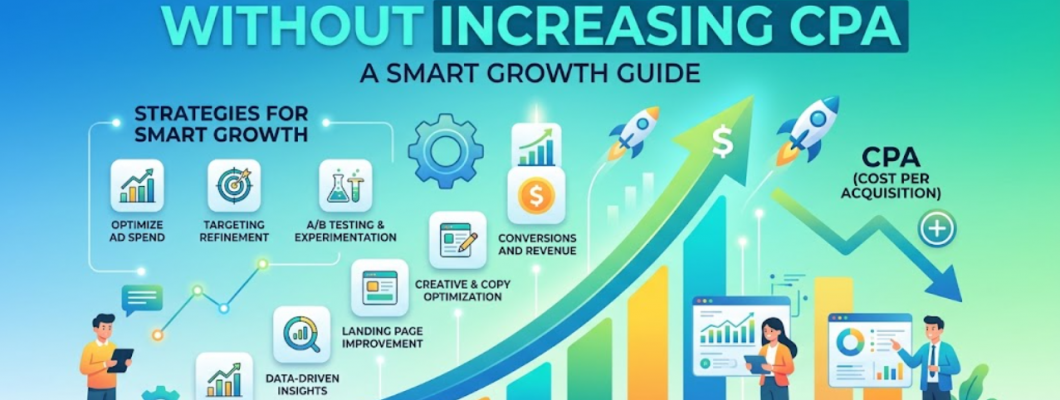
Scaling paid campaigns is a key objective for marketers, but it often leads to a common challenge rising Customer Acquisition Costs (CPA). As budgets increase, inefficiencies can surface, audience saturation may occur, and overall performance can start to decline.
So, how can you expand your campaigns while keeping profitability intact?
The solution lies in strategic scaling a focused approach that prioritizes efficiency while gradually increasing reach. Instead of simply spending more, it involves optimizing what’s already working, refining targeting, and making data-driven decisions to maintain strong performance.
By scaling thoughtfully, you can avoid unnecessary cost spikes and continue driving meaningful results. In this guide, we’ll explore practical, actionable strategies to help you grow your paid campaigns effectively without increasing your CPA.
Understanding the Challenge of Scaling
Scaling isn’t just about spending more—it’s about spending smarter.
When campaigns scale too quickly:
Audience fatigue increases
Conversion rates drop
CPCs (Cost Per Click) rise
CPA spikes
The goal is to balance volume and efficiency, ensuring your return on investment (ROI) remains strong.
1. Strengthen Your Foundation Before Scaling
Before increasing your budget, ensure your campaigns are optimized.
Key checks:
High-performing creatives identified
Strong conversion rates on landing pages
Proper tracking and attribution setup
Clear audience targeting
Scaling a weak campaign only amplifies inefficiencies.
2. Leverage Data-Driven Decision Making
Data is your most powerful tool when scaling campaigns.
Focus on:
Conversion rate trends
Cost per click (CPC)
Click-through rate (CTR)
Audience performance
Identify what’s working and double down on it instead of guessing.
3. Scale Gradually, Not Aggressively
One of the biggest mistakes marketers make is increasing budgets too quickly.
Best practice:
Increase budget by 10–20% every few days
Monitor performance after each change
Adjust based on results
Gradual scaling helps algorithms adapt without disrupting performance.
4. Expand High-Performing Audiences
Instead of targeting new, untested audiences immediately, expand your best-performing ones.
Strategies:
Use lookalike audiences based on converters
Broaden targeting slightly (age, location, interests)
Retarget engaged users
This approach maintains quality while increasing reach.
5. Refresh and Test Creatives Regularly
Creative fatigue is a major reason for rising CPA.
What to do:
Rotate ad creatives frequently
Test new visuals, headlines, and formats
Analyze which creatives drive conversions
Fresh creatives keep your audience engaged and improve performance.
6. Optimize Landing Pages for Conversions
Driving more traffic is pointless if your landing page doesn’t convert.
Improve:
Page load speed
Mobile responsiveness
Clear call-to-action (CTA)
Trust signals (reviews, testimonials)
Even small improvements in conversion rate can significantly reduce CPA.
7. Use Smart Bidding Strategies
Automation can help maintain efficiency at scale.
Consider:
Target CPA bidding
Maximize conversions
ROAS-based strategies
Let algorithms optimize bids based on real-time data.
8. Diversify Your Channels
Relying on a single platform can limit growth and increase costs.
Expand to:
Google Ads
Facebook & Instagram Ads
LinkedIn Ads (for B2B)
YouTube or Display networks
Different platforms offer new audiences and lower competition.
9. Test, Learn, and Iterate Continuously
Scaling is not a one-time action—it’s an ongoing process.
Always test:
New audiences
Ad formats
Messaging angles
Offers
Continuous experimentation helps you find new growth opportunities without increasing CPA.
10. Retarget to Maximize Conversions
Retargeting is one of the most cost-effective ways to scale.
Focus on:
Website visitors
Cart abandoners
Previous customers
These audiences are already familiar with your brand, making them more likely to convert at a lower cost.
11. Improve Offer & Value Proposition
Sometimes, the issue isn’t your ads—it’s your offer.
Enhance:
Discounts or bundles
Free trials or demos
Limited-time offers
A stronger offer increases conversion rates, helping maintain a low CPA.
12. Align Marketing with Customer Journey
Not all users are ready to convert immediately.
Create funnel stages:
Awareness (top-of-funnel)
Consideration (mid-funnel)
Conversion (bottom-of-funnel)
Tailor your messaging for each stage to improve efficiency.
13. Monitor Frequency & Avoid Ad Fatigue
Showing the same ad too often can reduce engagement.
Keep an eye on:
Ad frequency
Declining CTR
Rising CPC
If performance drops, refresh creatives or adjust targeting.
14. Use Audience Segmentation
Segmenting your audience allows for more personalized targeting.
Examples:
New vs. returning users
High-value vs. low-value customers
Different geographic locations
Personalized campaigns perform better and reduce wasted spend.
15. Focus on Lifetime Value (LTV), Not Just CPA
Scaling becomes easier when you consider long-term value.
Why it matters:
Higher LTV justifies higher acquisition costs
Repeat customers reduce overall CPA
Better ROI over time
Invest in retention strategies alongside acquisition.
Pro Tips for Scaling Without Increasing CPA
Don’t scale everything at once – focus on top performers
Keep testing creatives – avoid stagnation
Watch metrics daily – catch issues early
Stay patient – scaling takes time
Balance automation with manual control
Final Thoughts
Scaling paid campaigns without increasing CPA isn’t about shortcuts it’s about strategy, discipline, and continuous optimization.
By focusing on data, refining your targeting, improving creatives, and optimizing your funnel, you can achieve sustainable growth without sacrificing efficiency.
Remember, the goal isn’t just to spend more it’s to grow smarter.
When done right, scaling becomes a powerful engine that drives consistent results, higher ROI, and long-term success.
Leave a Comment